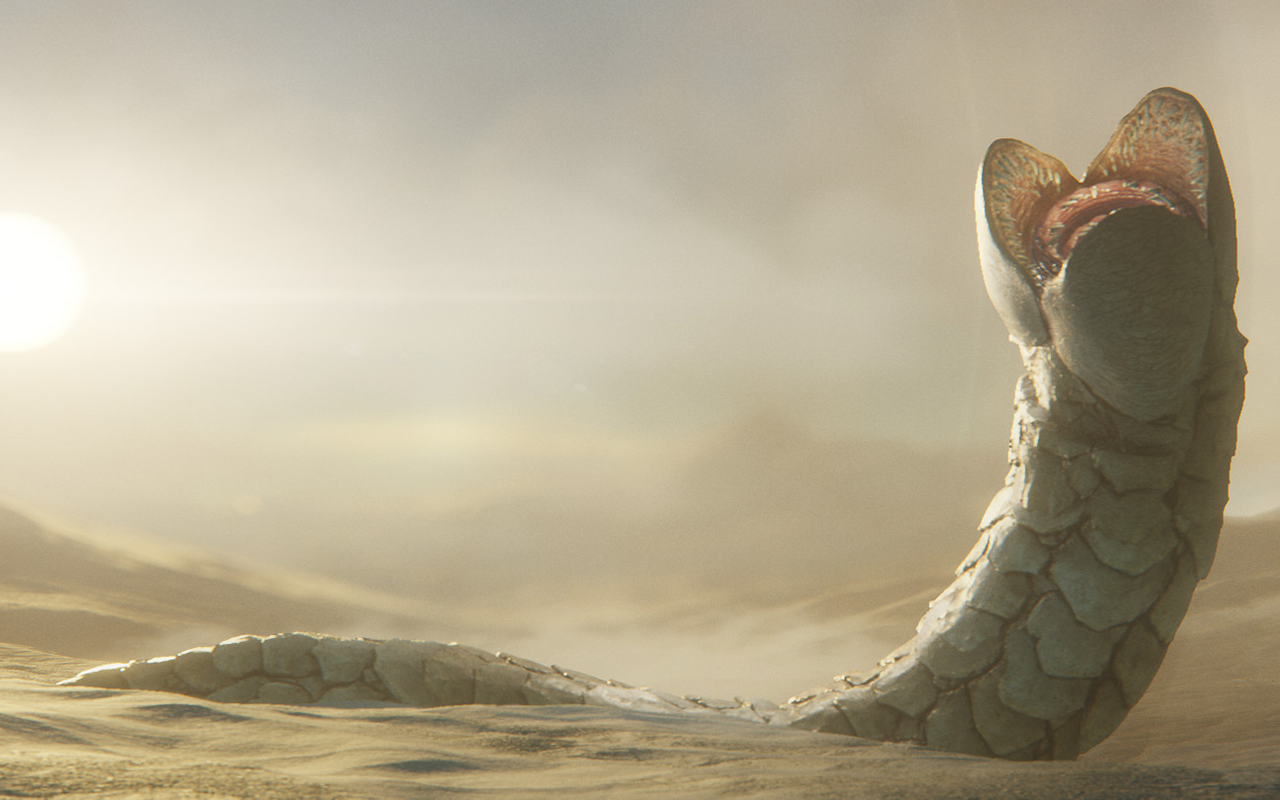
VALAKKAR
The valakkar is a colossal worm indigenous to the deserts of Leir III. The largest animal on the planet, in rare cases they can grow over 300 meters long. Valakkar are born from clutches of eggs that are laid in shallow nests in the desert. When the young emerge, they burrow into the sand, where they spend the majority of their lives. They move with the aid of overlapping plates that grip the ground and push them along without the need for limbs. As omnivores, they subsist on a mixed diet of vegetation, detritus, and meat, and have evolved to need very little water to survive. They are known to attack settlements, which makes the construction of permanent habitation on Leir III very difficult. Valakkar that are removed from their home world and introduced to new environments often become invasive.
DESCRIPTION
The juvenile, adult, and apex stages of the valakkar differ from one another in multiple ways. Juveniles are earthy brown with semi-hard plates that are dotted with tooth-like protrusions, which help them push their way through the underground tunnels they make. Their beaks, not yet fully formed, are covered with a durable, jagged-edged shield that drops off when the juvenile approaches adulthood. Adults are sandy brown and have rough overlapping plates that are cracked in places due to everyday wear and tear, through which you can see the scales' reddish brown interior. Their mouths are ringed with three hard, curved, beak-like mandibles that are used to help the valakkar dig holes and grasp prey. Valakkars that have reached the apex stage are more than 150 meters long, and their plates are dark brown with ruddy scratches across their surfaces. Some apex valakkars that have lived an especially long time can reach over 300 meters in length. All stages of the valakkar have a throat thronged with rows of teeth that continually grow throughout the animal's life.BEHAVIOR AND ECOLOGY
After they hatch from their eggs, juveniles from the same clutch often travel together. Without the thick, tough plates they will develop as adults, juveniles are vulnerable to predation, especially on their original world Leir III. Juveniles in groups use strength in numbers to fend off potential threats or to take down prey below and above ground, which they are able to sense through vibrations in the earth. Adults also travel in groups for a time, but they tend to become more solitary as they age. Apex valakkars are fully solitary, and breed rarely.When a valakkar is ready to breed, it leaves its childhood brood and travels hundreds of kilometers to seek out a suitable mate. Adults are fiercely protective of their nests, only leaving them alone when they must eat. If an apex finds an active nest in its territory it will often claim it for itself, allowing the adults that laid the nest to leave, recover their strength, and lay another clutch elsewhere. Most nests contain between two and ten eggs, but when their population is under threat valakkars lay larger clutches, sometimes up to twenty at a time.